
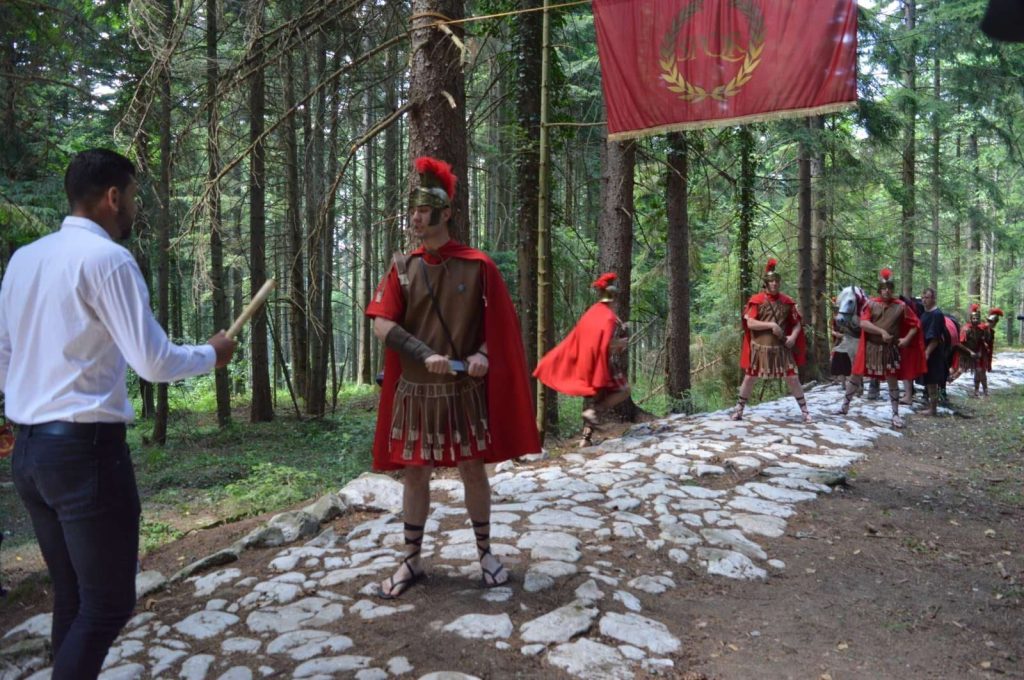
When, as a traveler, researcher, tourist, or nature enthusiast, you head toward Muška Voda, Paučko Lake, or perhaps Stara Karaula on the beautiful Konjuh Mountain in the Municipality of Kladanj, you may come across a sign reading “Roman Road” or “Roman Pavement.”
You may have seen the sign before, but did you know that behind the introduction of this Roman road into academic literature stands a name from the University of Tuzla?
Indeed, it was Prof. Dr. Mersiha Imamović from the Department of History at the Faculty of Philosophy, University of Tuzla, who, through her scientific research, brought the Roman road and Ottoman caravan routes on Konjuh Mountain (Kladanj) into scholarly discourse.
According to Professor Imamović, these sites “testify to the continuity of life in this area.”
The Roman road is also the first discovered monument from the Roman period in Kladanj and only the second such monument identified in Tuzla Canton.

Professor Mersiha Imamović
A Research Process That Lasted Several Months
“During 2020, I worked intensively in the field and remember dedicating my entire annual leave to this project, which was implemented by the University of Tuzla and financially supported by the Federal Ministry of Education and Science,” recalls Professor Imamović.
The research began based on assumptions made by earlier scholars (E. Pašalić and I. Bojanovski) that a Roman road came from the direction of Olovo, continued across the Stara Karaula pass, descended into Kladanj, and from there likely extended toward Srebrenica. However, no field research on the ancient roads of Konjuh had previously been conducted.
“The sign reading ‘Roman Pavement’ at the Miljkovac locality within the Konjuh Protected Landscape was also my starting point,” says Prof. Imamović.
However, “it quickly became clear that this pavement had nothing to do with Roman roads but was in fact an Ottoman caravan route.”
“I then began speaking with elderly local residents who recalled from their childhood and youth where they had encountered remnants of stone paving. I also consulted employees of the Konjuh Protected Landscape and the Tuzla Canton Forestry Company—people who knew the terrain well. Step by step, I reached the Metaljka locality, where I discovered remains of a Roman road, and later the Dobra Voda locality, known only to a few residents, where dense vegetation had largely covered the pavement. It was a process that required both human effort and physical endurance in order to access the road and carefully clear it for examination,” Professor Imamović explains.
Distinguishing Roman Roads from Ottoman Caravan Routes
Professor Imamović notes that the results of her research were published in relevant scientific journals, clearly distinguishing Roman roads from Ottoman caravan routes and refuting interpretations that mistakenly label Ottoman roads as Roman.
“Research conducted on Konjuh Mountain resulted in new scientific findings. These discoveries include:
- Roman roads at the Metaljka (Vrh) and Dobra Voda localities; and
- Ottoman caravan routes at the Miljkovac, Paljevac, and Buševo localities.
All of these sites are located within the Municipality of Kladanj. Prior to this research, only Miljkovac was known. According to local oral tradition, the site contained a ‘Roman pavement.’ However, the research established that the road was actually built during the Ottoman period.
The Roman road continued to be used throughout the Middle Ages and later during Ottoman rule. From the late nineteenth century, during Austro-Hungarian administration, and continuing to the present day, new roads have been built in the Kladanj area, some following the routes of Roman roads or Ottoman caravan paths—a fact also confirmed by this research” (Imamović, 2021).
“Unlike the cleaned Ottoman pavement at Miljkovac (130 meters long), which had a sign identifying it as a ‘Roman pavement’ and attracted many visitors due to its visibility, traces of the road at Dobra Voda were visible only in a few places. At both Dobra Voda and Metaljka, nothing had been cleared before our work, making it impossible to determine the nature of the paving from the few stones visible on the surface. Only after clearing the terrain could a professional analysis be conducted, leading to the conclusion that it was a Roman road” (Imamović, 2021).
The Route of the Roman Road
“From Dobra Voda, the road descended via the Vojnik locality into the Drinjača River valley, approximately where today’s marketplace is located in the town of Kladanj.
Within Kladanj, the Roman road split into two directions. One branch likely followed the Drinjača valley toward Šekovići and the Drina River, connecting further north to the Sava River and the cities of the Roman province of Pannonia, and upstream toward Argentaria (the wider area of present-day Srebrenica).
The second branch extended from Kladanj through Plahovići and the Plandište locality, above the Drinjača weekend settlement, crossed the Osica River, and reached Mramorak. From there, one route led through Ponijerk to Brateljevići, while another passed through Pauč, Metaljka, and Usjelina before descending into the Drinjača valley and reaching the Pekara locality, today known as Muška Voda” (Imamović, 2021).
Miljkovac: Not Roman, but Ottoman
“Miljkovac was the first site we investigated and where we established that the road was an Ottoman caravan route one meter wide. Its route extends from Kladanj through Plahovići and Tuholj to Miljkovac, with a total length of 8,290 meters. Further field inspections revealed that the traces of this road continued beyond Miljkovac. Examination of Austro-Hungarian maps suggested that one branch may have led toward Banovići and another toward Stupari” (Imamović & Krpić, 2021).
Professor Imamović concludes that the pavement at Miljkovac is Ottoman rather than Roman.
International Recognition of the Research
For those who thought archaeology was exciting only in movies, this story proves otherwise.
https://www.hippocampus.si/ISSN/2350-5443/2-2021/2350-5443.9(2)11-28.pdf
http://historija.ff.untz.ba/articles/HM6%20-%20Imamovic.pdf
This fascinating and demanding research resulted in a scientific article on the Roman road published in Slovenia in 2021 in Studia Universitatis Hereditati, a journal published by the University of Primorska in Koper.
The discovery was also presented to the public through a performance during the Summer University of Tuzla in 2021.
Professor Imamović proudly emphasizes that:
“Projects such as this directly position the University of Tuzla as a leader of scientific thought in Bosnia and Herzegovina through field research, cooperation between academia and local communities, and the transformation of historical hypotheses into tangible material evidence.”
She further notes:
“This multidisciplinary research process demonstrates that the University of Tuzla is capable of leading complex research projects, thereby fulfilling its social responsibility while promoting Bosnia and Herzegovina’s cultural and historical heritage. Publishing scientific papers in international journals such as Studia Universitatis Hereditati ensures global academic visibility.”
“A Significant Difference Exists Between Knowing About an Old Road and Scientifically Establishing Its History”
The significance of Professor Imamović’s research was also highlighted by Nedim Rabić, research associate at the Institute of History of the University of Sarajevo and one of the organizers of the international conference At the Crossroads of History: Transport, Space, and Society Through the Past of Bosnia and Herzegovina.
“I believe the greatest value of this research lies in the fact that a route previously known only to part of the local population and users of the area became the subject of systematic scientific investigation, documentation, and professional interpretation.
There is a substantial difference between knowing that an old stone-paved road exists somewhere and scientifically establishing that it is a communication route of a specific age, function, and historical context.
Thanks to Professor Imamović’s research, this route has become part of academic literature and verifiable scientific knowledge. What was once limited to local memory and familiarity with the terrain is now accessible to both domestic and international researchers. Such studies make an important contribution to understanding the cultural and historical heritage of Bosnia and Herzegovina and open new opportunities for research into historical transportation networks.”
The next time you pass a sign reading “Roman Road,” take a moment to imagine the dedication, perseverance, and enthusiasm of the research team whose work transformed local knowledge into internationally recognized scientific evidence—something we can all be proud of today.